Artificial Intelligence (AI) is no longer a futuristic concept, it’s a competitive necessity. From predictive analytics to intelligent automation, organizations across industries are leveraging AI to streamline operations, improve customer experiences, and drive innovation.
But successfully integrating AI into an organization requires more than just adopting new tools. It demands strategic planning, cultural alignment, and long-term vision.
Artificial Intelligence is not about replacing human intelligence, it’s about amplifying it. Organizations that strategically integrate AI into their processes today are building the foundation for smarter decisions, faster innovation, and sustainable competitive advantage tomorrow.
In this comprehensive guide, we’ll explore the top strategies for integrating AI in organizations, helping you maximize ROI while minimizing disruption.
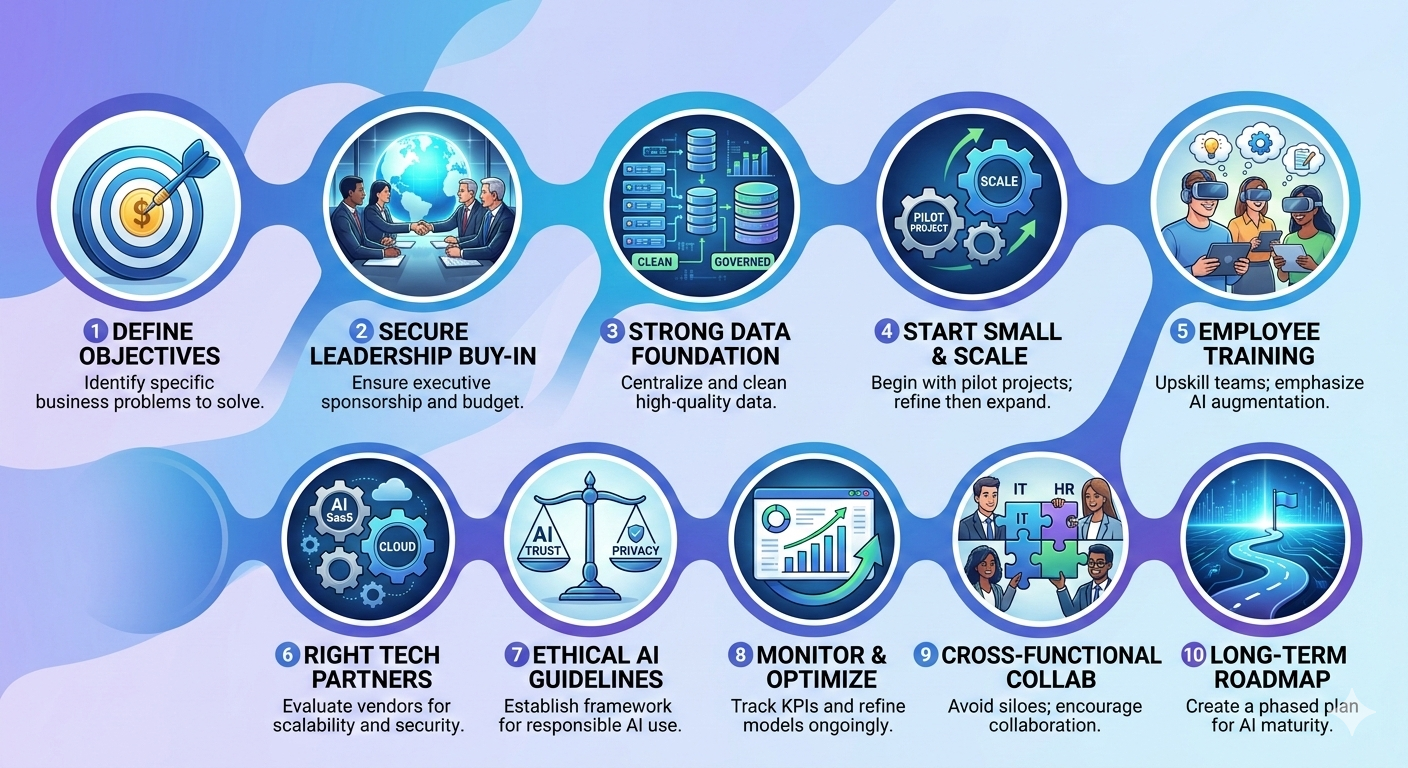
1. Define Clear Business Objectives
Before implementing AI, organizations must identify specific business problems they want to solve.
Ask:
- Are you trying to reduce operational costs?
- Improve customer service?
- Increase sales forecasting accuracy?
- Automate repetitive tasks?
AI should align with measurable business goals, not be adopted simply because it’s trending.
Pro Tip: Start with high-impact, low-risk use cases to demonstrate early wins and build internal confidence.
2. Secure Leadership Buy-In
AI transformation must be driven from the top. Executive sponsorship ensures:
- Adequate budget allocation
- Strategic alignment
- Cross-department collaboration
- Long-term commitment
When leadership understands how AI supports organizational goals, adoption becomes smoother and more sustainable.
3. Build a Strong Data Foundation
AI systems are only as good as the data they’re trained on.
Organizations must:
- Centralize data sources
- Clean and standardize data
- Ensure data governance policies
- Maintain compliance with regulations
Without high-quality data, even the most advanced AI models will underperform.
4. Start Small and Scale Gradually
Instead of a company-wide AI overhaul, begin with pilot projects. For example:
- AI-powered chatbots in customer service
- Predictive maintenance in manufacturing
- Smart inventory forecasting in retail
Evaluate performance, gather feedback, and refine before scaling across departments.
This approach reduces risk and improves implementation success rates.
5. Invest in Employee Training and Change Management
One of the biggest barriers to AI adoption is employee resistance. People fear automation will replace their roles.
To overcome this:
- Provide AI literacy training
- Emphasize AI as an augmentation tool
- Upskill teams for AI-enhanced roles
- Encourage innovation culture
When employees understand AI supports their work rather than replaces them, engagement increases significantly.
6. Choose the Right Technology Partners
Not every organization needs to build AI solutions from scratch.
Consider:
- AI SaaS platforms
- Cloud-based machine learning services
- Strategic AI consulting partners
Evaluate vendors based on:
- Scalability
- Security
- Integration capabilities
- Support services
The right technology ecosystem accelerates implementation and reduces technical debt.
7. Establish Ethical AI Guidelines
Responsible AI adoption is critical. Organizations must address:
- Bias in algorithms
- Data privacy concerns
- Transparency in decision-making
- Regulatory compliance
Creating an internal AI ethics framework builds trust among customers, employees, and stakeholders.
8. Monitor, Measure, and Optimize Continuously
AI integration is not a one-time project, it’s an ongoing process.
Track KPIs such as:
- Cost reduction
- Efficiency gains
- Customer satisfaction scores
- Revenue growth
Regular performance audits help refine AI models and ensure alignment with evolving business needs.
9. Foster Cross-Functional Collaboration
AI initiatives often fail when siloed within IT departments.
Encourage collaboration between:
- IT and Data Teams
- Operations
- Marketing
- HR
- Customer Service
Cross-functional alignment ensures AI solutions address real-world business challenges.
10. Develop a Long-Term AI Roadmap
AI maturity evolves over time. Organizations should create a phased roadmap:
Phase 1: Pilot and experimentation
Phase 2: Department-level integration
Phase 3: Enterprise-wide AI transformation
A strategic roadmap ensures sustainable growth rather than reactive implementation.
10. Develop a Long-Term AI Roadmap
AI maturity evolves over time. Organizations should create a phased roadmap:
Phase 1: Pilot and experimentation
Phase 2: Department-level integration
Phase 3: Enterprise-wide AI transformation
A strategic roadmap ensures sustainable growth rather than reactive implementation.
Benefits of Successfully Integrating AI in Organizations
When implemented strategically, AI can deliver:
- Increased operational efficiency
- Better decision-making through predictive analytics
- Improved customer personalization
- Reduced human error
- Competitive advantage
Organizations that prioritize structured AI integration are more likely to achieve long-term digital transformation success.
Final Thoughts
Integrating AI in organizations requires thoughtful planning, cultural adaptation, and continuous optimization. Companies that align AI initiatives with business objectives, invest in people, and build strong data infrastructures are best positioned to thrive in an AI-driven future.
By following these top strategies for integrating AI in organizations, your business can unlock innovation, efficiency, and sustainable growth.
If you’re looking to develop a customized AI integration strategy for your organization, start by assessing your readiness today, the future of business is intelligent.
Leave a Reply